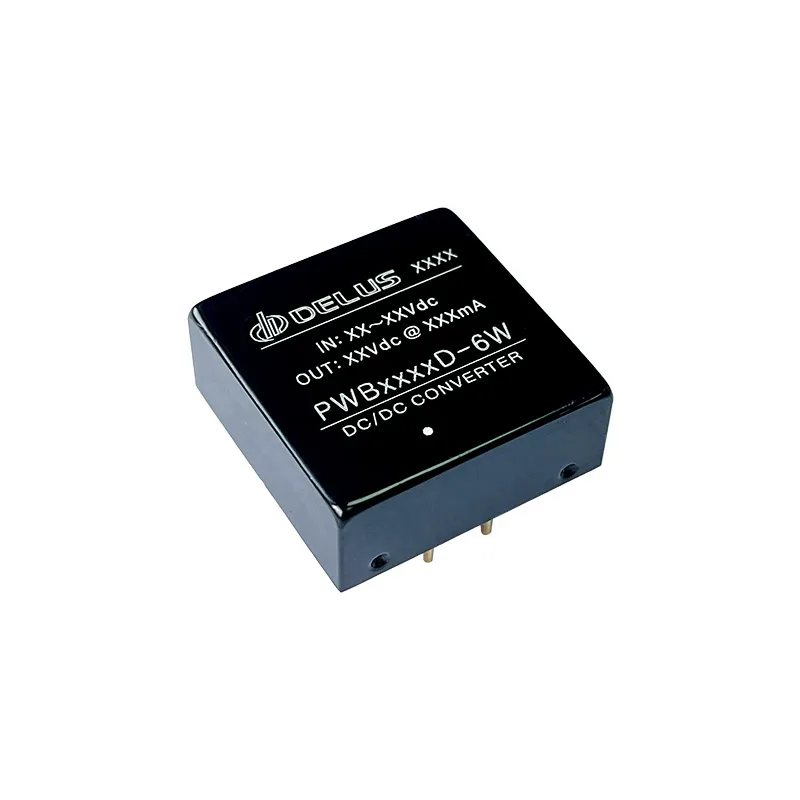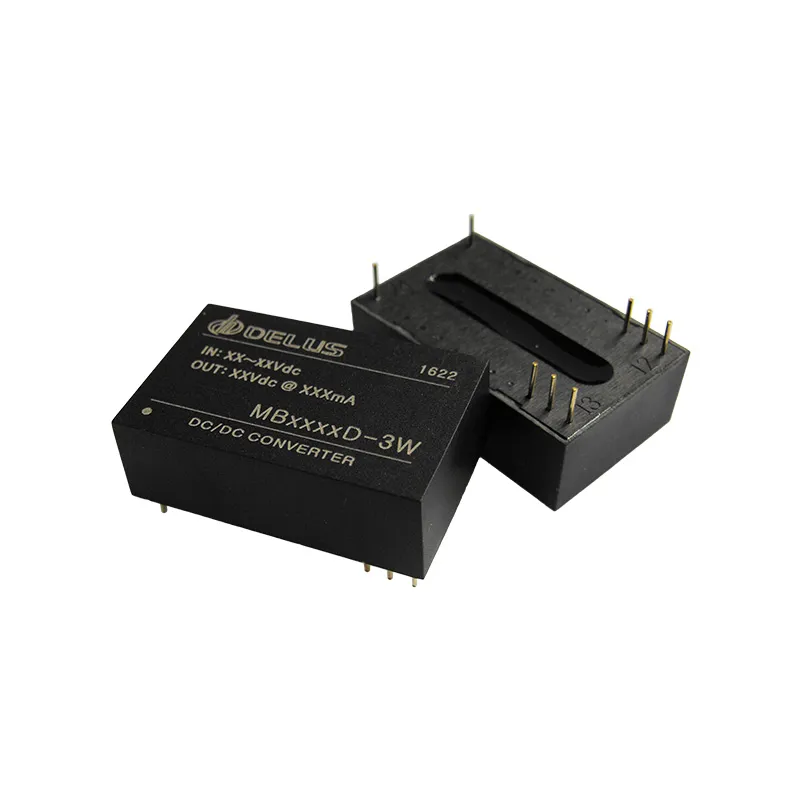

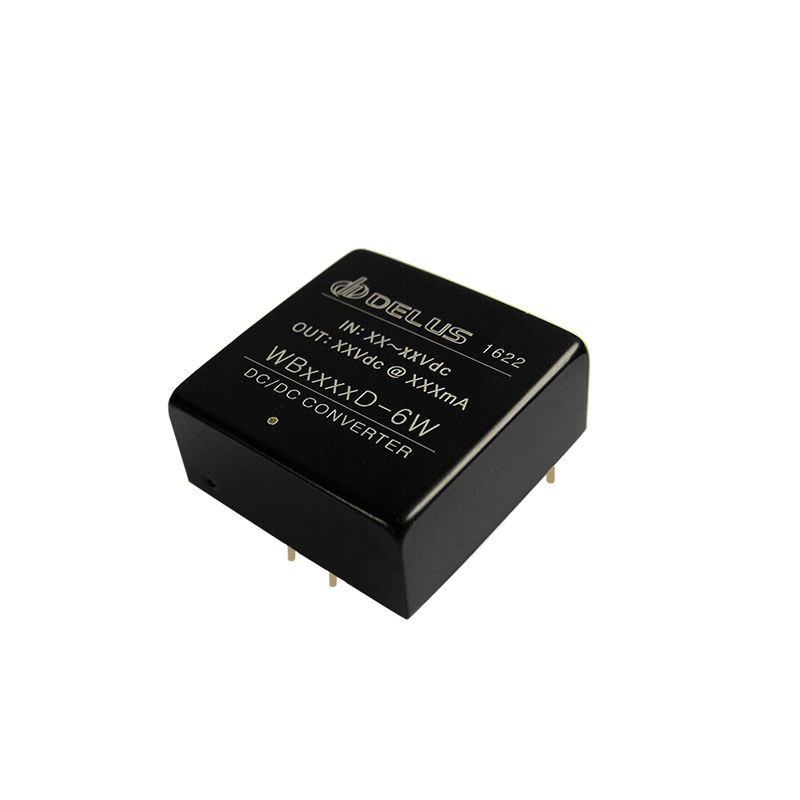


WB_D-6W Series 6W Wide Input Isolated DC-DC Converter
1500V Isolation | Regulated Single Output | 2:1 Wide Range Input
Features
- Operating temperature: -40 to +85℃
- 9-18/18-36/36-72Vdc input
- 5V/9V/12V/15V/24V output
- Efficiency up to 88%
- Ultra-low noise & ripple
- Bare module meet CISPR22/EN55022 Class B
- 100% burn-In
- No external heat sink
- Continuous short circuit protection
- RoHS/CE multiple compliance
- With 3 years warranty
- Case size 25.4×25.4×10.2mm
Overview
WB_D-6W series power converter compact, high power density, can save valuable board space to reduce product volume. It has the characteristics of wide input voltage range, low starting current, good load characteristics and minimum noise characteristics.
The chip ceramic capacitors and SMT are used in all series. These converters have characteristics of long life, excellent performance, stability and reliability.
Selection Guide
Specifications
- Series Name
- WB_D-6W
- Input Voltage
- 9~18V,18~36V,36~72V
- Output Voltage
- 5V,9V,12V,15V,24V
- Output Power
- 6W
- I/O Isolation
- 1500V
- Output Regulation
- Regulated
- Footprint Type
- DIP
- No of Outputs
- 1
- Voltage Set Accuracy
- ±1% typ.
- Regulation
- 0.1% typ.
- Ripple and Noise
- 80 mVp-p max.
- Temperature Coefficient
- ±0.03%/℃ max.
- Short Circuit Protection
- Continuous (automatic recovery)
- Transient Response
- 500 μs typ. (25% Load Step)
- Output Filter
- Internal Pi-Type
FAQs
1. What is a wide voltage power module?
Wide input voltage range, stable output under voltage fluctuation, ideal for industrial, automotive and battery-powered applications.
2. Difference between wide voltage & normal modules?
Normal modules have narrow input range; wide voltage modules have better adaptability and anti-interference for complex conditions.
3. How to choose input voltage range?
Select with 10%–20% margin. 9–36V for industrial, 18–75V for automotive.
4. Can it work beyond rated voltage?
No. Overvoltage may trigger protection or damage the module. Use within rated range only.
5. Need external input protection?
Fuse, reverse polarity protection, TVS and filter capacitors are recommended for reliability.
6. Low output & poor load capability?
Check input voltage, load, wiring drop and over-temperature derating.
7. How to reduce ripple & noise?
Add output filter, shorten wiring, optimize grounding and reduce inductive interference.
8. Frequent restart & protection?
Usually caused by overload, short circuit, abnormal input or overheating. Test without load first.
9. What protections are built-in?
Under-voltage, over-current, short-circuit, over-temperature protection with auto-recovery.
10. Can be series or parallel connected?
Not recommended without voltage/current sharing, may cause module damage.
11. Notes for high temperature application?
Derate 20%–50% above 70℃, improve heat dissipation to avoid over-temperature protection.
12. What’s the function of isolation voltage?
Improve safety, suppress interference, protect loads and personnel.