

LDO vs. DC-DC Power Modules: Working Principles, Performance Comparison, and Engineering Selection Guide
LDO (Low Dropout) regulators and DC-DC power modules are the two mainstream voltage regulation solutions in electronic circuit design. Broadly speaking, an LDO is a type of DC-DC voltage converter. However, in industrial applications, LDO specifically refers to linear regulators, while DC-DC denotes switching power modules. These two solutions differ significantly in their working principles, internal architectures, performance metrics, and application scenarios, forming the critical basis for power supply design selection.
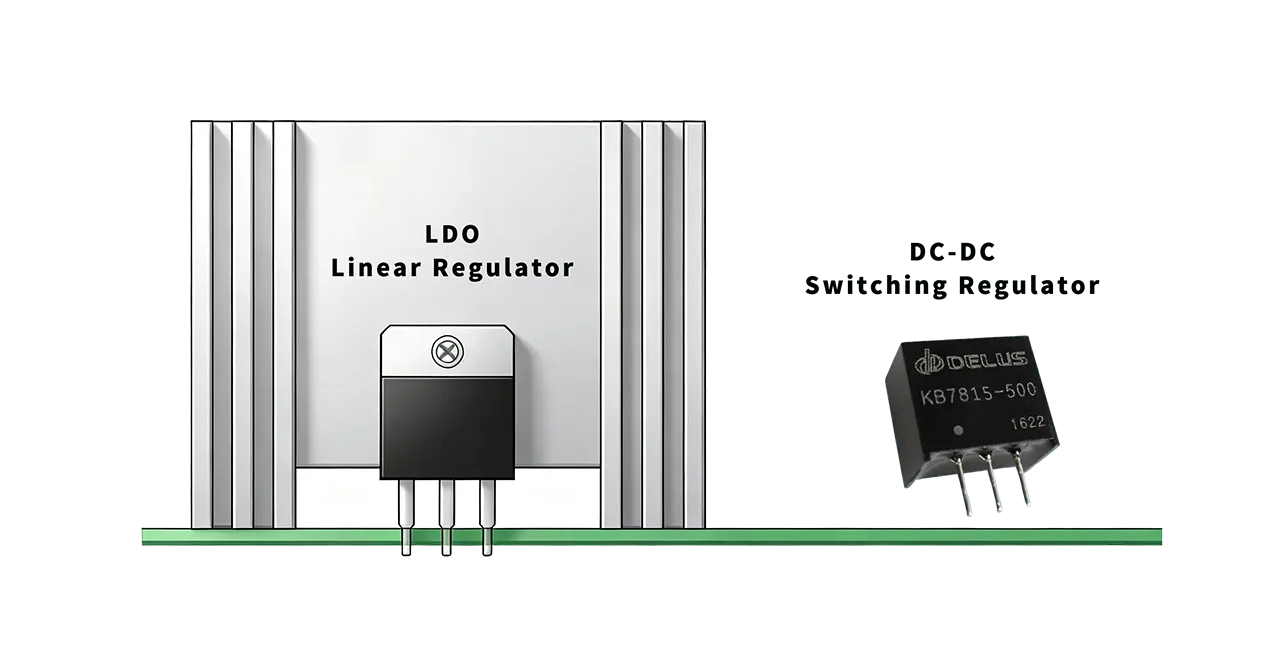
LDO Linear Regulators: High Precision, Low Noise, and Inherent Limitations
LDO linear regulators operate on a linear step-down principle, meaning they can only step down the input voltage and cannot perform boost or buck-boost conversions. Their core advantages include ultra-low output ripple, fast transient response, and excellent voltage stability. Featuring a simple circuit topology, an LDO typically requires only one or two external bypass capacitors to operate, offering low cost, low noise, and low quiescent current. Consequently, they are widely used in low-current, high-precision circuits that demand strict power supply noise control.
Nevertheless, LDOs have inherent technical limitations. They suffer from low conversion efficiency and significant heat generation, particularly when the voltage differential between the input and output is large. Furthermore, the load current capacity of LDOs is constrained, with mainstream industrial models typically maxing out at 5A. High-current operation necessitates bulky external heat sinks, which severely restricts their scope of application.
DC-DC Power Modules: High Efficiency and Wide Voltage Adaptability
Unlike linear LDOs, DC-DC converters utilize switching topologies—including buck, boost, and buck-boost configurations—and can be categorized into isolated and non-isolated types. Isolated DC-DC modules offer greater design flexibility and can often replace non-isolated alternatives in demanding industrial scenarios.
The most significant advantages of DC-DC modules are their high conversion efficiency and ultra-wide input voltage ranges. The Delus KB7805 series, for instance, supports an input voltage range from 6.5V to 32V, making it highly adaptable to complex and fluctuating power environments, ensuring stable equipment operation even during grid fluctuations.
Technological Breakthroughs: Bridging the Output Ripple Gap
Traditionally, switching DC-DC modules were considered to have slightly slower transient responses and higher output ripples compared to LDOs. However, with continuous advancements in power supply technology, the performance of high-end DC-DC modules has improved dramatically. Thanks to technological innovation, the historical performance gap between the two in terms of dynamic response and output ripple is rapidly narrowing.
For example, the Delus KB7805-1000 module can maintain full-load output ripple below 10mVp-p without requiring any external filter components. This technological breakthrough achieves performance levels that closely rival those of LDOs, perfectly solving the traditional high ripple pain point of switching power supplies.
Engineering Selection Guide: LDO vs. DC-DC
Structurally and functionally, LDOs are simple, precise, and low-noise, but they are inefficient and prone to thermal issues. In contrast, DC-DC power modules feature high integration, wide voltage adaptability, robust load capacity, and high energy efficiency.
When it comes to component selection:
- Choose LDOs: Ideal for low-current, high-precision, and noise-sensitive precision circuits (e.g., sensor power supplies, RF circuits).
- Choose DC-DC Modules: The optimal solution for industrial equipment, automation control systems, and communication base stations requiring wide input voltages, high currents, and continuous long-term operation.
With the maturation of miniaturization and low-ripple technologies, high-performance DC-DC modules, represented by Delus, are increasingly replacing traditional LDOs, emerging as the mainstream solution for modern industrial power supply designs.