

DSP-Controlled Digital Isolated Bidirectional DC/DC Converter
Driven by rapid advancements in information technology, digital control architectures have revolutionized modern power electronics. As power conversion hardware and digital signal processing mature, digitally controlled switching converters have been widely deployed. Nevertheless, high-frequency PWM converters still face inherent design challenges that demand targeted optimization.
Digital signal processing delivers distinct advantages over analog control implementations: simplified computer-based regulation, zero analog signal transmission distortion, improved immunity to stray electromagnetic interference, and native support for embedded self-diagnosis and fault-tolerant algorithms.
In the early integration of microcontrollers into power electronics, digital hardware only handled auxiliary tasks such as data monitoring and display to implement system-level supervision. With the evolution of digital technology, microprocessors have taken over core loop control functions. Dedicated digital PWM controllers gain widespread adoption for their low power draw and insensitivity to analog component parameter drift. They feature seamless digital system interfacing and enable complex, fully optimized control algorithms, widely deployed for voltage regulator modules (VRMs), audio amplifiers, and portable consumer electronics.
Digitally controlled power electronics replace discrete analog PWM hardware with digital controllers to regulate high-speed power switches for energy conversion. Duty-cycle quantized digital control delivers tangible performance improvements compared to conventional analog loops. Digital filters enable flexible dynamic compensation: if the filter sampling frequency matches the converter switching frequency, quantized duty-cycle controllers operate stably across full frequency bands without extra compensation networks. Dynamic response characteristics can be modified instantly by updating filter weight coefficients. Basic digital controllers also natively support built-in functions including output current limiting and soft-start.
This paper summarizes the evolution and core strengths of digital power control. Based on the operating principle of full-bridge isolated bidirectional DC/DC converters, the design centralizes all control logic into embedded software to minimize external analog circuitry. Experimental verification confirms adjustable output voltage and stable regulation performance, alongside software-implemented bidirectional power flow for constant-current battery charging. The experimental platform adopts the TMS320LF2407 DSP as the core digital controller, forming a universal fully-digital control solution for industrial power electronic equipment.
1 Basic Topology & Operating Principle of DSP-Controlled Bidirectional DC/DC Converters
Growing industrial manufacturing and energy storage demands drive rising adoption of bidirectional DC/DC converters, with key use cases including DC UPS systems, aerospace power networks, electric vehicles, DC power amplifiers and battery energy storage equipment.
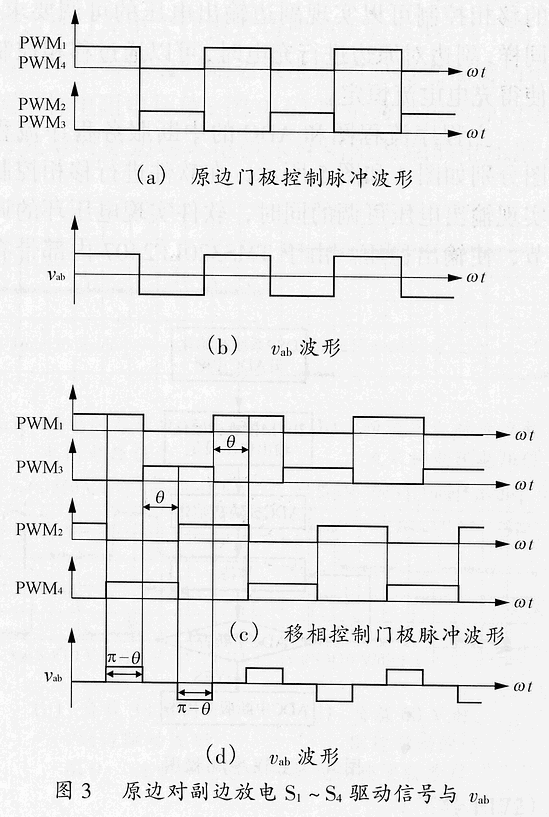
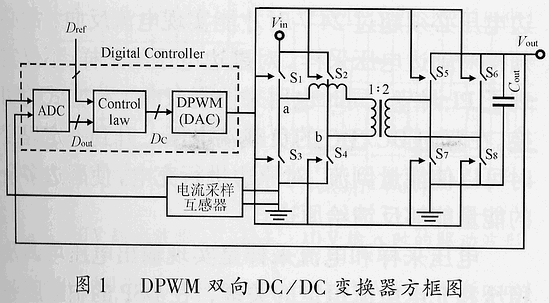
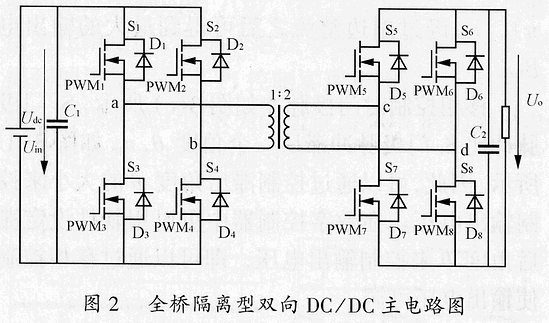
Figure 1 illustrates the basic topology of a DPWM-based bidirectional DC/DC converter. This research selects the full-bridge isolated bidirectional (DAB) topology as the primary experimental power stage.
The digital controller consists of three core modules: analog-to-digital converter (ADC), DPWM pulse generation unit, and discrete closed-loop control core. The ADC discretizes sampled output voltage Vout; the DPWM module converts calculated control variables into PWM drive signals; the discrete control unit executes feedback loop computation and modulation logic.
1.1 Forward Power Flow: Primary to Secondary Discharge
Under full-modulation operation, drive waveforms for switches S1–S4 are plotted in Figure 3 (ideal switching devices with dead-time omitted). In Figure 3(a), PWM1 and PWM4 operate in phase without phase shifting, generating the maximum secondary output voltage. Neglecting circuit losses, the secondary rail reaches n·Vin under full modulation. Secondary-side freewheeling diodes conduct for uncontrolled rectification. The primary bridge modulates DC input into an AC square wave, while secondary diodes demodulate the AC waveform back to regulated DC output, with no pulse blanking during full modulation. The transformer primary voltage Vab is shown in Figure 3(b). Each switch S1–S4 conducts for exactly half the switching period T/2, producing symmetric positive/negative AC half-cycles that yield maximum rectified secondary voltage.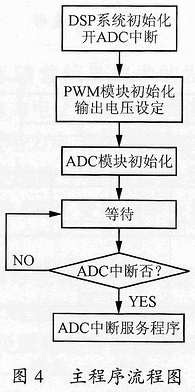
Phase-shift regulation introduces a lag angle θ between S1 and S4 gate signals, as illustrated in Figure 3(c), with corresponding Vab waveforms in Figure 3(d). Output voltage is continuously adjusted by tuning the phase lag θ, configured flexibly via DSP software for precise closed-loop regulation.
1.2 Reverse Power Flow: Secondary to Primary Battery Charging
For reverse energy transfer, swap drive signals between primary bridge S1–S4 and secondary bridge S5–S8, replacing primary voltage Vab with secondary voltage Vcd. Both full-modulation and phase-shift modes apply to reverse operation. Battery charging requires constant-current regulation, which is reliably achieved through phase-shift control. The power stage operates symmetrically opposite to forward discharge mode, and detailed waveforms are omitted for brevity.
2 Software Implementation of Digital Bidirectional DC/DC Control
Bidirectional DC/DC converters support two-way energy transfer: forward discharge demands adjustable regulated output voltage, while reverse charging requires constant charging current. Phase-shift modulation of primary switches S2 and S3 delivers stable adjustable secondary output voltage. Similarly, phase-shift tuning maintains constant charging current during reverse secondary-to-primary energy feedback.
Figure 4 and Figure 5 display the main program flow chart and ADC interrupt service routine flow chart respectively. The DSP software implements dual closed-loop phase-shift control for output voltage stabilization. Leveraging the integrated ADC peripheral of TMS320LF2407, LEM Hall sensors sample output voltage and feed analog signals into the DSP ADC module. The interrupt service routine reads sampled data, applies digital filtering, and executes incremental PI compensation to maintain tight output regulation.
Reverse charging relies on a dedicated current feedback PI loop to enforce constant battery charging current. The experimental setup uses a 12 V battery as the primary-side energy storage unit. Given the 1:2 transformer turns ratio, secondary voltage must exceed 24 V to forward-bias primary freewheeling diodes and enable reverse current flow. Secondary voltage sampling serves dual purposes: real-time PI regulation and bidirectional mode switching logic. When secondary load voltage rises above a predefined threshold, the converter automatically reverses power flow to feed excess energy back to the primary battery pack.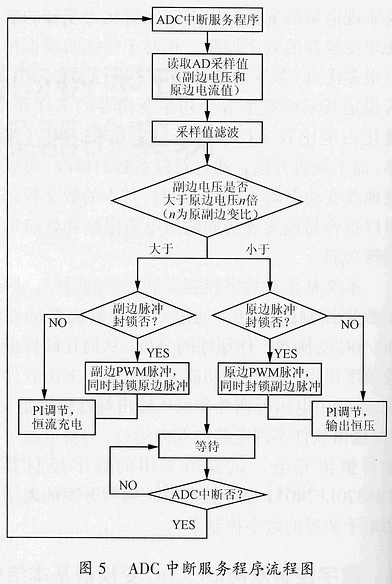
Voltage and current sampling form the foundation of adjustable output regulation and constant-current charging. Sampled signals are digitally filtered and processed via PI algorithms within the DSP interrupt routine. The controller executes incremental PI compensation against user-defined voltage and current reference values:
- If primary input voltage drifts, the secondary rail remains locked to the target setpoint;
- If secondary load voltage fluctuates, phase shift angles are adjusted to stabilize primary charging current.
The control scheme adopts incremental PI topology, with the system block diagram shown in Figure 6. The TMS320LF2407 DSP’s robust arithmetic unit and Event Manager (EV) peripheral simplify high-precision PWM generation, drastically reducing analog peripheral count and hardware complexity. All PI loop computation and pulse-width modulation logic are fully implemented via embedded software. Optocoupler isolation is retained between DSP and power stage for high-voltage safety isolation.
Conclusion
Digital signal processors enable full software control of isolated bidirectional DC/DC converters, eliminating most analog compensation circuits while supporting bidirectional energy flow, adjustable output regulation and constant-current battery charging via flexible phase-shift modulation. This DSP-based digital control topology delivers simplified hardware design, flexible algorithm iteration and stable long-term performance for energy storage, aerospace and automotive bidirectional power conversion systems.